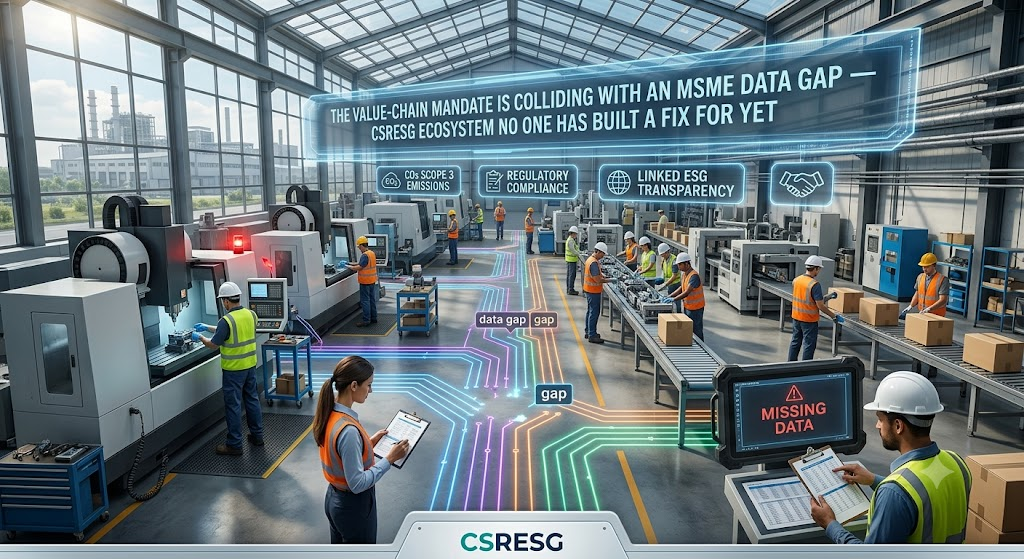




The Value-Chain Mandate Is Colliding With an MSME Data Gap No One Has Built a Fix For Yet
Signal:
Practitioner accounts from ESG advisory firms working directly on BRSR Core value-chain readiness describe a consistent operational problem: for a typical mid-cap manufacturer, the 20 to 40 key suppliers that would fall under mandatory value-chain disclosure are overwhelmingly MSMEs with no existing ESG reporting infrastructure. They don’t track Scope 1 and Scope 2 emissions. They don’t hold workforce diversity data in a reportable format. Safety incident registers, where they exist, don’t roll up cleanly into the kind of standardised indicator a listed company’s BRSR Core filing needs.
This isn’t a one-off complaint, it shows up as the central operational bottleneck across multiple independent readiness guides published in the first half of 2026, all describing the same shape of problem from different angles.
Source & Confidence
Source: Practitioner analysis from ESG advisory and compliance-consulting firms actively supporting BRSR Core value-chain readiness work, published across several independent guides in early-to-mid 2026.
Confidence: Medium. No single source here is a primary regulatory filing or a large-sample survey, this is practitioner-reported pattern-matching from firms doing the readiness work directly, which carries real signal but also reflects what consultancies are seeing in their own client base rather than a market-wide census.
What raises confidence above “Low”: the pattern is indirectly corroborated by SEBI’s own regulatory behaviour, a regulator doesn’t defer a mandatory disclosure rule twice, and shift the language from “assurance” to “assessment or assurance” to widen the pool of qualified assessors, unless it’s responding to a real capacity constraint on the ground. The practitioner accounts and the regulator’s own actions point the same direction independently.
Implications
This matters most for three groups, in roughly this order of urgency:
- Mid-cap listed manufacturers inside the top 250–500 companies by market capitalisation, who will need real vendor ESG data once assurance obligations turn mandatory from FY 2026–27, and currently have a voluntary window to build it rather than scramble for it.
- MSME suppliers themselves, who are about to become a reporting dependency for their largest customers whether or not they’ve been told so clearly, and who have the most to gain from getting ahead of lightweight ESG data collection before it’s demanded of them under time pressure.
- Whoever builds the simplest MSME-facing data collection tool first. The gap described here isn’t really a data problem, it’s a tooling and habit problem. A lightweight, low-friction way for a small manufacturer to log emissions, safety incidents and workforce data without needing a sustainability team is currently missing from the market, and the company or platform that fills it credibly has a real head start.
Watch For
- Whether SEBI’s FY 2026–27 assurance milestone holds as scheduled, or gets deferred a third time, a third deferral would be strong confirmation that the MSME data gap is structural, not transitional.
- Whether value-chain disclosure scope widens from the top 250 toward the top 500 companies on the same timeline as BRSR Core’s own assurance mandate, if the two timelines start to diverge, that’s a signal the vendor layer is being treated as structurally harder, not just administratively deferred.
- Early movers among large listed companies who begin publishing real (not just policy-level) vendor engagement data ahead of the mandatory deadline, these are the case studies worth tracking as the practical playbook for everyone else.