



Why two ESG rating agencies can give the same Indian company completely different scores
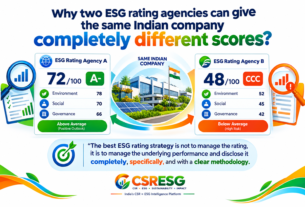
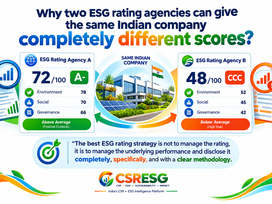
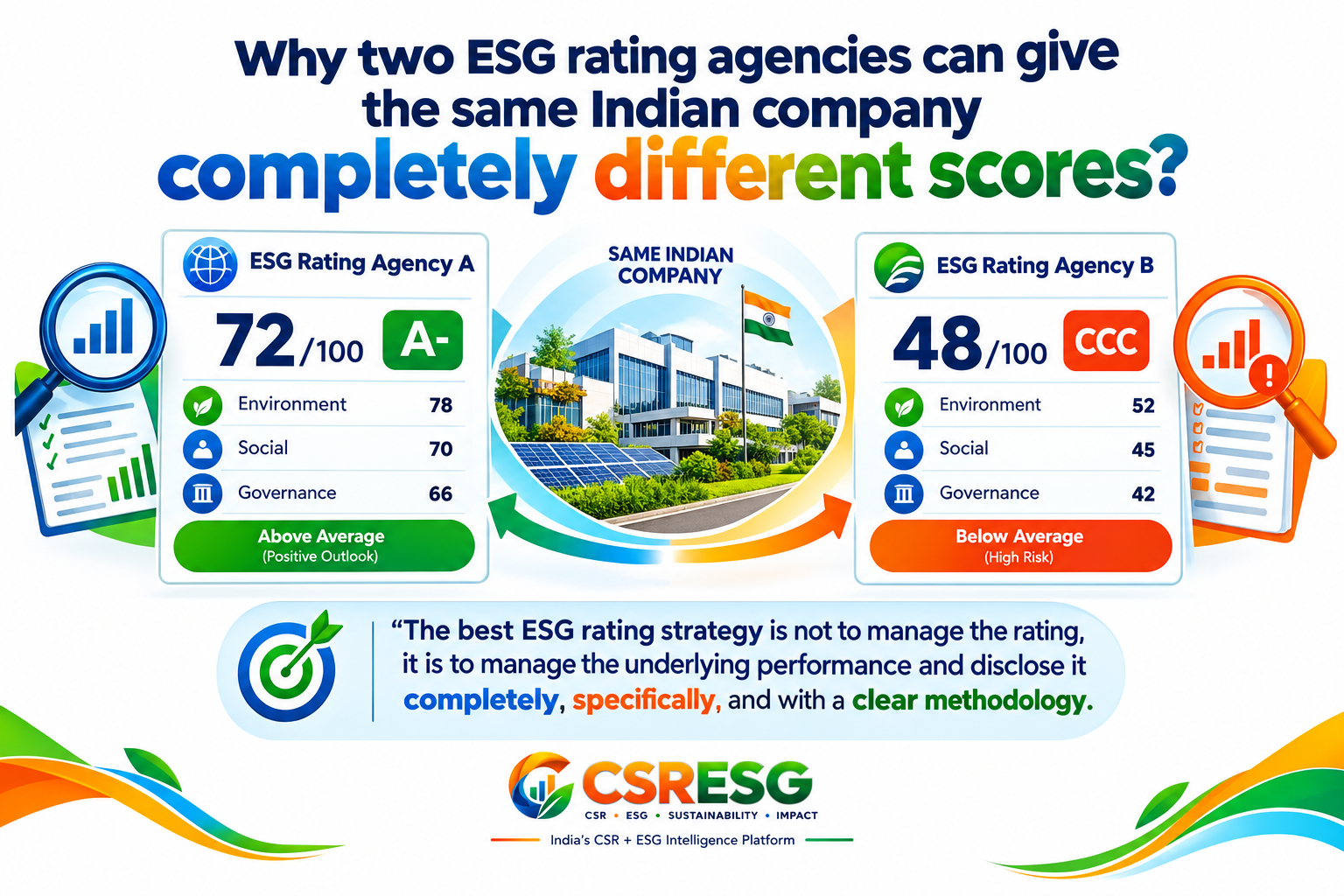
This is one of the most important things to understand about the ESG landscape that most people working in it have not yet internalised: if you look up the ESG rating of a large Indian company from two different agencies, you may find that one rates it as a strong ESG performer and the other rates it as poor. This is not a rounding error. It is a structural feature of the ESG ratings market, it has been quantified by academic research, and it has real consequences for how capital flows to Indian companies.
The Berg, Koelbel and Rigobon finding
In 2020, Florian Berg, Julian Koelbel, and Roberto Rigobon, researchers at MIT Sloan, published a paper called “Aggregate Confusion: The Divergence of ESG Ratings.” They found that the average correlation between the ESG ratings of major international agencies was just 0.54 much lower than the correlation between credit ratings from different agencies (around 0.99) and lower than most analysts assumed. Two agencies rating the same company were producing substantially different assessments more often than not.
The paper identified three sources of this divergence. First, measurement divergence: agencies measure the same concept differently. “Employee health and safety” might be operationalised as LTIFR by one agency and as the presence of an EHS management system by another. Second, scope divergence: agencies include different issues in each ESG pillar. One agency might include product safety under Social; another might classify it under Governance. Third, weight divergence: even when agencies measure and scope the same issue, they weight its importance differently by sector. A water use intensity improvement matters more to a water-stressed steel manufacturer than to a software company but different agencies implement this sector adjustment differently.
Why India amplifies this problem
The rating divergence problem is worse in India than in developed markets for two reasons. The first is data availability. Indian BRSR disclosures, while improving, are still inconsistent in depth and methodology. When primary data is thin, rating agencies fill gaps with proxies, estimates, and industry averages and different agencies use different proxies. A company with strong actual ESG performance but weak disclosure gets rated poorly by data-dependent methodologies and better by methodology-dependent ones.
The second reason is the relative immaturity of India-specific ESG analytical frameworks. International rating agencies calibrate their models primarily on developed-market corporate behaviour, meaning some of their benchmarks are poorly suited to Indian industrial structures, labour markets, and regulatory environments. CRISIL and ICRA, which assess Indian companies with local context, often produce ratings that diverge from MSCI or Sustainalytics precisely because they are accounting for different things.
What SEBI’s ERP framework does about it
SEBI’s 2023 ESG Rating Provider (ERP) framework is India’s regulatory response to this problem. It requires ESG rating agencies operating in India to register with SEBI, publish their rating methodologies in detail, disclose their data sources and refresh frequencies, manage conflicts of interest explicitly, and publish the rationale behind individual company ratings rather than just the score. The goal is to make rating methodologies comparable and contestable so that a company, an investor, or a regulator can understand why a score was assigned, not just what it was.
The ERP framework does not eliminate rating divergence, the underlying differences in methodology are too fundamental for disclosure alone to resolve. But it does reduce the ability of agencies to treat their methodology as a black box, and it gives companies a clearer basis for engaging with and contesting ratings they believe are inaccurate.
The practical implication for practitioners
For a CSR or ESG professional advising an Indian company on its ESG rating exposure, the lesson is specific: the quality and completeness of your BRSR disclosure is itself a rating input. Agencies that rely heavily on company-disclosed data rate transparent disclosers more accurately than opaque ones and in the absence of good data, agencies tend to assume the worst. A company with strong actual environmental performance that discloses its GHG data incompletely will be rated worse than its actual performance warrants, because the agency cannot verify what the company has not disclosed.
This means the best ESG rating strategy is not to manage the rating, it is to manage the underlying performance and disclose it completely, specifically, and with a clear methodology. Ratings that reflect reality are more durable than ratings engineered through disclosure management.