


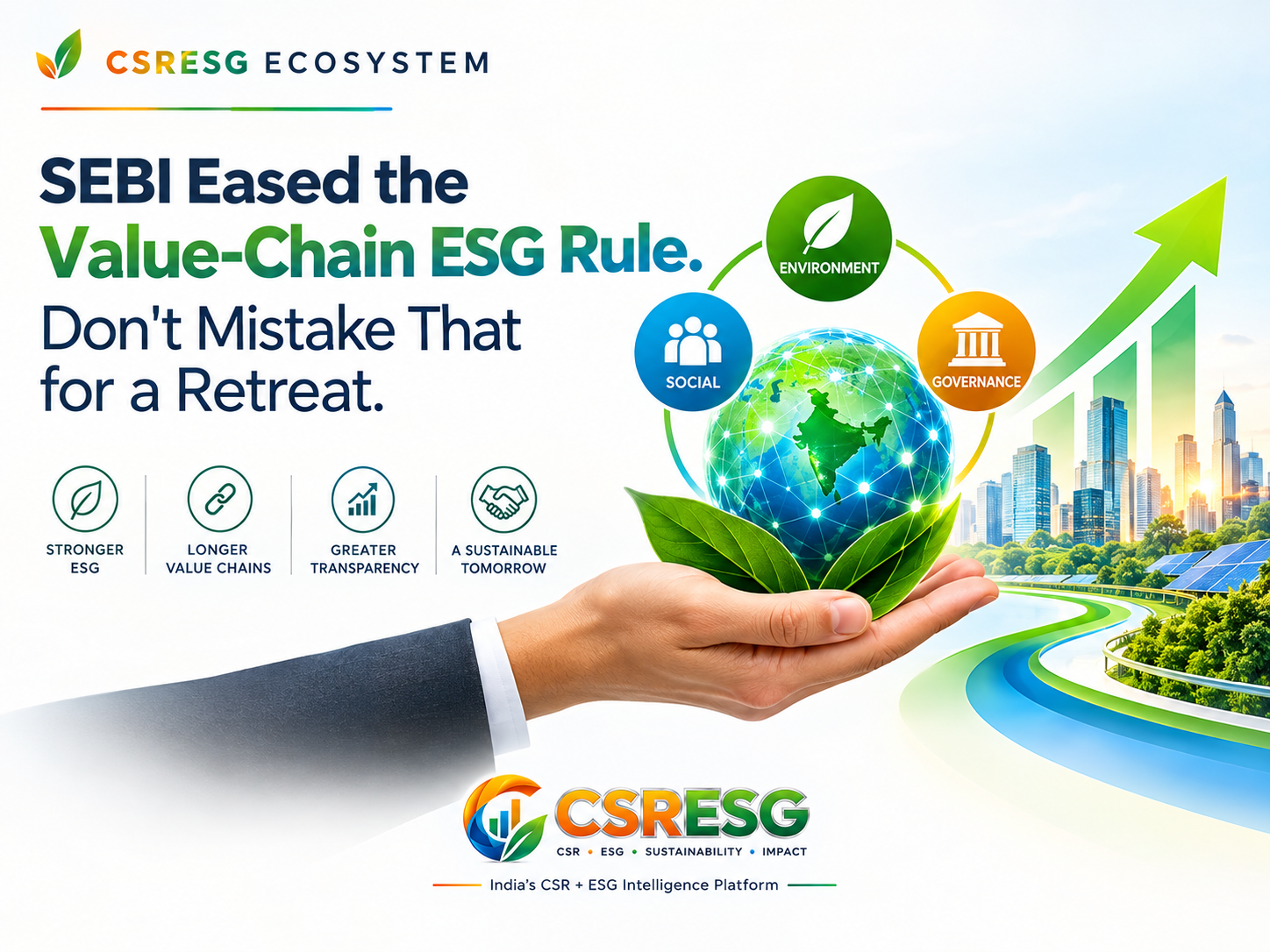
SEBI Eased the Value-Chain ESG Rule. Don’t Mistake That for a Retreat.
India’s market regulator has twice pulled back the deadline for mandatory ESG disclosure across corporate supply chains most recently making it voluntary rather than compulsory. The softening isn’t regulatory retreat. It’s regulatory honesty about a readiness gap the market hasn’t solved yet.
What Happened
SEBI’s Business Responsibility and Sustainability Reporting (BRSR) Core framework requires India’s top listed companies to disclose standardised ESG data – emissions, water use, workforce diversity, and more, across roughly 140 indicators. The requirement has been rolling out in phases since FY 2023-24, starting with the top 150 companies by market capitalisation and expanding each year.
The value-chain layer, where listed companies report ESG data not just for themselves but for the key suppliers and customers who make up 2% or more of their purchases or sales was originally meant to be mandatory from FY 2024-25. SEBI deferred that deadline once, in December 2024, pushing it to FY 2026. Then, in a circular dated 28 March 2025, SEBI went further: value-chain disclosure for the top 250 listed companies is now voluntary for FY 2025–26, with the assessment or assurance obligation also voluntary, starting FY 2026–27.
Meanwhile, the assurance requirement on companies’ own BRSR Core metrics has kept expanding on schedule from the top 150 companies in FY 2023-24 to the top 500 in FY 2025-26, with the full top 1,000 scheduled for FY 2026-27.
Why It Matters
The pattern is telling: SEBI is holding the line on what companies must report about themselves, while repeatedly softening what they must report about their vendors. That’s not an accident of drafting. It’s a tacit acknowledgment that most Indian suppliers overwhelmingly MSMEs, don’t yet have the systems to produce audit-ready ESG data on demand.
This is precisely the gap we’ve been naming all year: sustainability commitments that hold at the reporting entity but thin out fast once you move one link down the supply chain. A regulator softening a vendor-disclosure deadline isn’t proof the vendor problem doesn’t matter, it’s proof the market infrastructure to solve it doesn’t exist yet, for anyone.
What’s Next
Value-chain assurance is still scheduled to become mandatory from FY 2026-27, and the disclosure scope is expected to widen from the top 250 Companies toward the top 500 and eventually further, mirroring how BRSR Core’s own assurance mandate has expanded. Whether that timeline holds will depend on whether large listed companies and the consultancies and platforms serving them actually close the MSME data gap in the next 12-18 months, or whether SEBI defers again.
Sources: SEBI’s Revised BRSR Core Circular (28 March 2025) as reported by Slaughter and May’s ESG in APAC briefing and Reporting Academy; BRSR Core phased-assurance timeline as reported by IMARC Engineering, Beacon Filing and Breathe ESG.