


BRSR Core – Reviewed
Rigorous Where It’s Aimed, Silent Where It Isn’t
SEBI’s Business Responsibility and Sustainability Reporting Core framework is, by design, one of the more demanding ESG disclosure regimes in the world for the companies it covers directly. Where it falls short is the part every company depends on but can’t fully control: the vendors standing just outside its current reach.
What We Reviewed
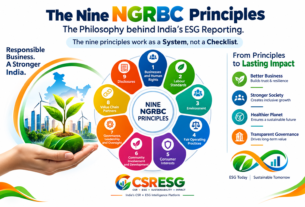
BRSR Core is the audited subset of India’s broader BRSR framework, roughly 30 key performance indicators drawn from a wider set of about 140 indicators across nine principles, covering emissions, water, waste, workforce safety and diversity, and governance. It’s been rolling out in phases since FY 2023-24: reasonable assurance started with the top 150 listed companies by market capitalisation and is scheduled to cover the full top 1,000 by FY 2026-27. This review looks at the framework as it stands in 2026, based on SEBI’s own circulars and industry guidance from ESG advisory firms tracking its rollout.
Strengths
- It moved ESG reporting from narrative to numbers. Before BRSR Core, sustainability reporting in India leaned heavily on prose, the kind of report that reads well and verifies badly. A defined KPI set with mandatory third-party assurance forces companies to produce numbers an auditor can actually check, not just a story a marketing team can tell.
- The phased rollout is genuinely sensible design. Starting with the top 150 companies and widening gradually gives both companies and the (still-thin) pool of qualified ESG assurance professionals time to build capacity, rather than demanding audit-ready data from 1,000 companies on day one.
- Industry-developed reporting standards reduced ambiguity fast. Joint guidance from SEBI, ASSOCHAM, FICCI and CII on how to compute intensity ratios and handle boundary-setting closed a lot of the interpretation gaps that made early BRSR Core filings inconsistent across companies.
Gaps
- The vendor layer is where the framework’s confidence visibly drops. Twice deferred, now voluntary, see our companion News piece on the March 2025 recalibration. A framework this rigorous about a company’s own Scope 1 and 2 emissions is markedly softer the moment the question becomes “what about the people who supply you?”
- Enforcement teeth are thin relative to the ambition. Non-compliance penalties reported under SEBI’s listing obligations run to roughly ₹2,000 per day, with escalation possible, a meaningful nuisance for a small company, arguably a rounding error for the large caps this framework primarily targets.
- “Assurance” still means different things to different assessors. SEBI’s own shift in language from “assurance” to “assessment or assurance” was a pragmatic move to widen the pool of qualified professionals, but it also means two companies’ BRSR Core filings may have been checked to genuinely different standards of rigour, which undercuts the comparability the whole framework is built to deliver.
Verdict
BRSR Core deserves real credit for what it set out to do at the reporting-entity level: it’s turned ESG disclosure in India from a writing exercise into an audited one, and the phased rollout shows a regulator that learned from other markets’ mistakes. Where it’s currently weakest is exactly where the sustainability conversation is hardest, the vendor and supply-chain layer and the repeated deferrals there are a symptom of a real capacity gap, not a design flaw the regulator can simply legislate away. Companies that treat the voluntary value-chain window as optional rather than as a head start are reading this framework’s current leniency as license. It isn’t.