


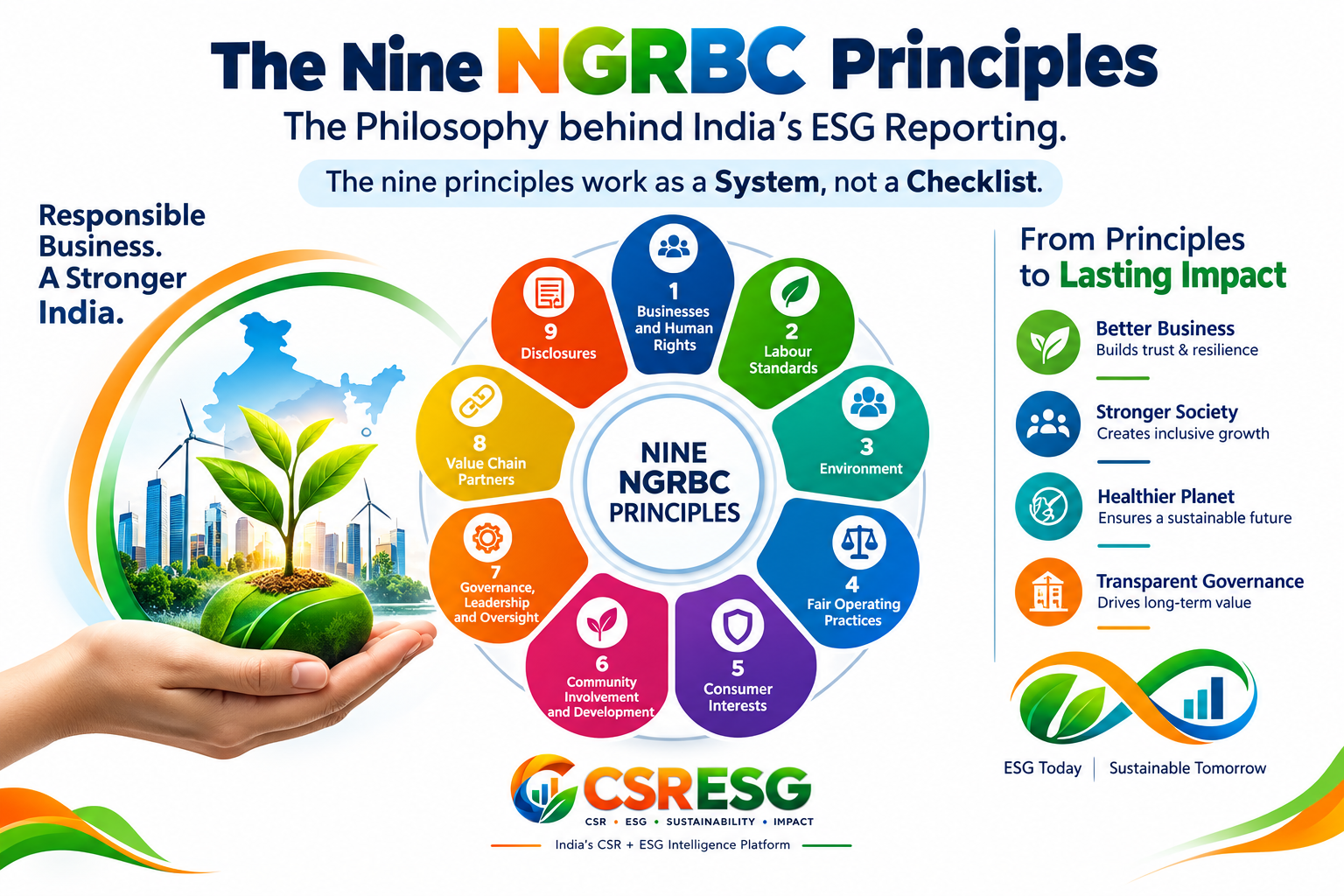
The Nine NGRBC Principles
The Philosophy behind India’s ESG Reporting
Most people who work with BRSR treat the nine NGRBC principles as a filing structure, a set of bins into which disclosures are sorted. This is a mistake. The nine principles of India’s National Guidelines on Responsible Business Conduct are a coherent statement of values, developed by the Ministry of Corporate Affairs after years of stakeholder consultation, that describe what it means for a company to operate responsibly in a society as complex as India’s. Understanding them as philosophy rather than taxonomy changes how you read every BRSR report you will ever open.
Where the Principles came from
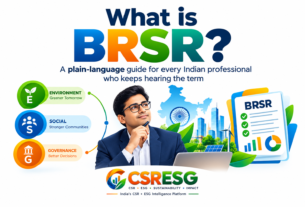
The NGRBC did not emerge fully formed. Their predecessor, the National Voluntary Guidelines on Social, Environmental and Economic Responsibilities of Business (NVGs), was published in 2011 and represented India’s first attempt to give corporate responsibility a structured, government-endorsed framework. The NVGs were revised and upgraded to the NGRBC in 2019, incorporating human rights due diligence, responsible supply chain management, and an explicit requirement for board-level accountability. BRSR operationalises the NGRBC by translating each principle into measurable disclosure requirements.
Principle 1: Ethics, transparency and accountability
The first principle asks companies to conduct and govern themselves with integrity, in a manner that is Ethical, Transparent and Accountable. It sounds like a preamble rather than a requirement, but its operationalisation in BRSR is specific: companies must disclose their anti-corruption and anti-bribery policies, the number of proceedings under competition law, the number of conflicts of interest declared, and whether they have a functional whistleblower mechanism. The quality of Principle 1 disclosures in Indian BRSR filings varies enormously, the gap between a company with a functioning ethics infrastructure and one performing it for compliance is visible in the specificity of these disclosures.
Principle 2: Sustainable products and services
The second principle requires companies to be responsible for the environmental and social impacts of their products and services across their life cycle, from raw material sourcing through end-of-life. This is the principle that most directly engages with circular economy concepts and extended producer responsibility (EPR), now mandatory for several categories of plastic and e-waste in India. Principle 2 disclosures are among the weakest in the current BRSR landscape, particularly for sectors where life-cycle impacts are significant but complex to measure.
Principle 3: Employee wellbeing
The third principle covers employee and worker wellbeing – a category that, under BRSR, extends explicitly to contract workers and not just permanent employees. BRSR requires companies to disclose training hours, safety performance (LTIFR), parental leave return rates, and pay equity data separately for employees and workers, precisely because the wellbeing gap between permanent and contractual workforces in Indian industry is significant and systematically under-reported.
Principle 4: Stakeholder responsiveness
Principle 4 asks companies to identify and engage with all stakeholders, not just investors and customers, but communities, workers, and vulnerable groups and to be responsive to their needs and interests. This is the principle that most directly supports rigorous materiality assessment: genuine stakeholder engagement is what distinguishes a materiality process that reflects actual stakeholder priorities from one that reflects what the sustainability team expected stakeholders to say.
Principle 5: Human rights
The fifth principle, aligned with the UN Guiding Principles on Business and Human Rights, asks companies to respect and promote the human rights of all stakeholders, including supply chain workers and communities affected by operations. In Indian BRSR filings, human rights disclosures are consistently among the thinnest, companies often assert policy commitments without disclosing due diligence processes, remediation mechanisms, or outcome data.
Principle 6: Environmental stewardship
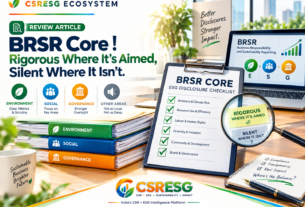
Principle 6 is the environmental pillar covering GHG emissions, energy, water, waste, biodiversity, and climate risk. It is the most data-intensive section of BRSR and, because GHG accounting methodology is more standardised than social impact measurement, often the most reliably disclosed. The introduction of BRSR Core made several Principle 6 indicators subject to independent assurance, which has improved data quality for the top 150 companies significantly.
Principle 7: Responsible policy engagement
The seventh principle is the most consistently avoided in Indian BRSR filings. It asks companies to engage with policymakers in a responsible and transparent manner, disclosing their policy advocacy positions, their trade association memberships, and, importantly, the advocacy positions of the associations they belong to. The reasoning is straightforward: a company that publicly commits to climate action while funding trade association lobbying against climate regulation is not operating with integrity. Most Indian companies leave this section incomplete.
Principle 8: Inclusive growth
Principle 8 asks companies to promote inclusive growth and equitable development, recognising that business operating in a society with India’s levels of inequality has responsibilities beyond tax compliance and labour law adherence. This is the principle most directly connected to CSR under Section 135: BRSR Principle 8 disclosures are where CSR programme data belongs, including outcomes measured, communities reached, and programme continuation plans.
Principle 9: Consumer responsibility
The ninth principle covers responsible engagement with consumers, product safety, fair marketing, data privacy, accessible grievance redressal, and sustainable consumption promotion. With India’s Digital Personal Data Protection Act now in force and consumer rights awareness growing, Principle 9 disclosures are receiving increasing regulatory and investor attention.
Reading the Principles together
The nine principles work as a system, not a checklist. A company that discloses strong environmental data under Principle 6 while leaving its Principle 7 policy advocacy section blank is telling you something important about the relationship between its public sustainability commitments and its private regulatory strategy. A company with strong Principle 3 employee data but thin Principle 5 human rights disclosures is revealing where its supply chain accountability breaks down.
The art of reading a BRSR lies in reading the principles together, as a coherent picture of a company’s actual relationship with responsibility, not as nine independent filing categories.