


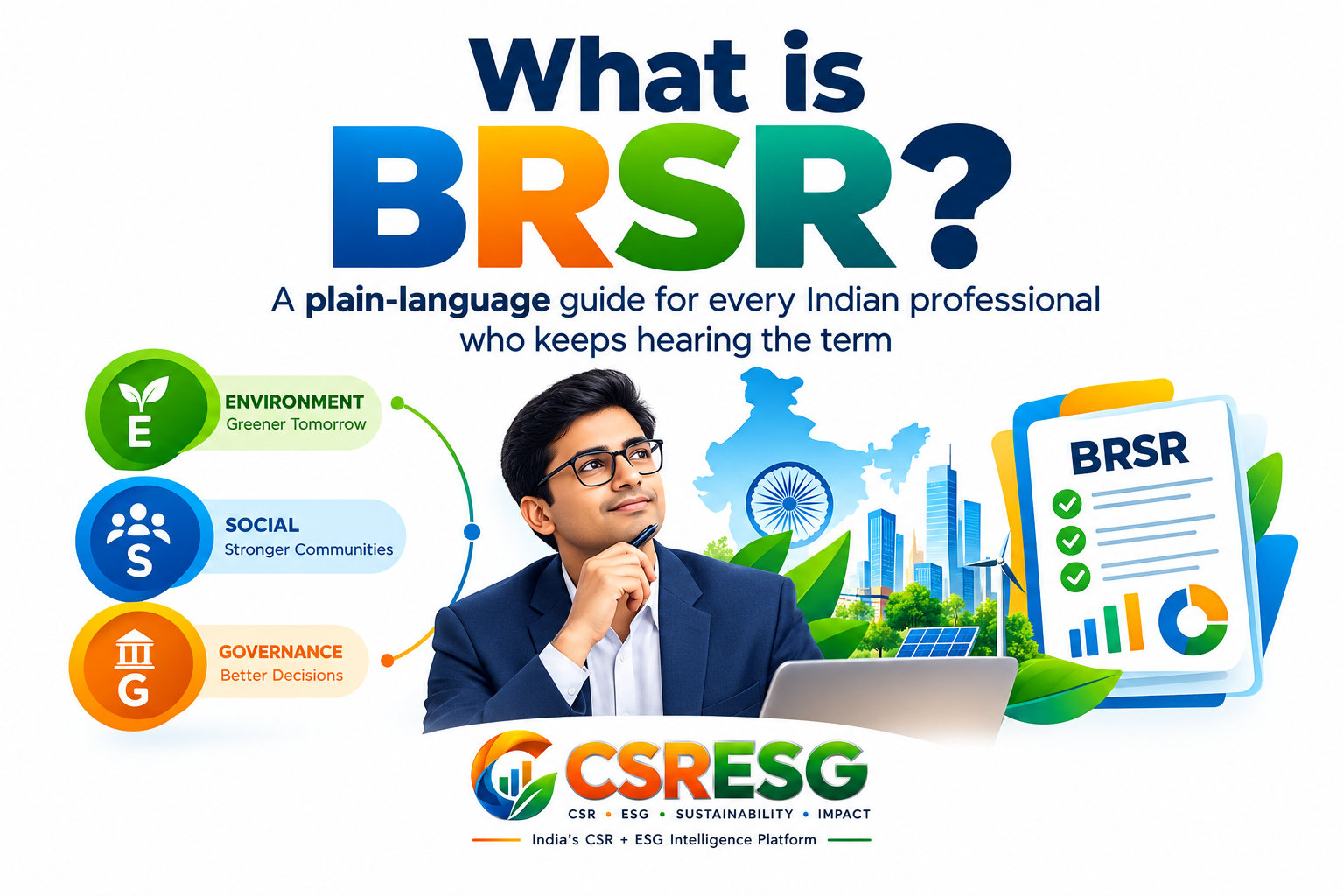
What Is BRSR? An ESG Guide
If you have spent any time near India’s corporate sustainability world in the last two years, you will have encountered the acronym BRSR in annual reports, in board presentations, in conference panel discussions, in job descriptions that didn’t exist three years ago. You may have nodded along while filing it away to research later. This is that research.
BRSR stands for Business Responsibility and Sustainability Report. It is India’s mandatory ESG (Environmental, Social, and Governance) disclosure framework for listed companies, introduced by SEBI – the Securities and Exchange Board of India – through a May 2021 circular. It replaced its predecessor, the Business Responsibility Report (BRR), which SEBI had mandated since 2012 but which had grown into a largely narrative, largely unverifiable exercise that told investors and stakeholders very little about what companies were actually doing.
BRSR was designed to fix that. It requires quantitative, comparable, annually filed disclosures on a company’s environmental performance, social practices, and governance quality, embedded in the main annual report filing rather than in a standalone sustainability document that nobody reads. Mandatory for India’s top 1,000 listed companies by market capitalisation from financial year 2022–23, it covers everything from greenhouse gas emissions and water consumption to gender pay ratios, employee safety records, and board diversity.
Why SEBI introduced it and Why now
The global context matters here. By 2021, ESG disclosure had become a mainstream expectation in international capital markets. Investors in Europe, North America, and increasingly Asia were demanding standardised, comparable sustainability data from the companies they owned. India’s pre-BRSR disclosure landscape, narrative BRRs, voluntary sustainability reports of wildly varying quality, and Section 135 CSR reports focused on spend rather than impact was not producing data that global investors could use. For a market as large and as globally connected as India’s, that gap was becoming a competitive disadvantage.
Domestically, the case was equally clear. India had spent a decade building a CSR culture through Section 135, but the data on whether that spend was producing genuine outcomes was thin. Investors, creditors, and regulators had no reliable way to compare how different companies were managing environmental risk, treating their workforces, or governing themselves. BRSR was designed to build that comparability and to do it on a regulatory timeline that meant companies couldn’t opt out.
The Three-section Structure
BRSR is organised into three sections, each serving a different purpose:
Section A (General Disclosures) establishes context: who the company is, what it does, how large it is, how it is governed, and what its stated commitments on sustainability look like. This section includes governance disclosures, whether a sustainability committee exists, who is accountable for ESG performance, whether executive remuneration is linked to ESG targets, that are strategically important but consistently among the most poorly answered in the current universe of Indian BRSR filings.
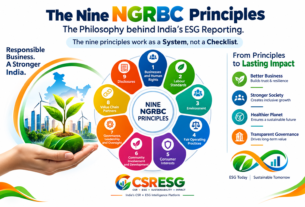
Section B (Management and Process Disclosures) asks companies to describe how they operationalise the nine NGRBC principles, what policies exist, who is responsible, what training is provided, how stakeholders are engaged. This section reveals whether sustainability is structurally embedded in the company or managed as a separate exercise.
Section C (Principle-wise Performance Disclosures) is where the data lives: quantitative indicators on GHG emissions, water and energy consumption, waste generation, gender pay ratios, employee safety statistics, CSR programme outcomes, human rights compliance, and consumer grievance data, all organised against the nine NGRBC principles. This is the section investors, ESG rating agencies, and researchers use most heavily.
Essential vs Leadership Indicators
Within Section C, BRSR distinguishes between Essential indicators, which every qualifying company must answer and Leadership indicators which are voluntary, signalling above-baseline ambition. In practice, the ratio of Leadership indicators answered to Essential indicators answered is a useful proxy for a company’s ESG maturity: companies that only answer Essential indicators are compliant but not credible.
BRSR Core: the Accountability Step-change
In 2023, SEBI introduced BRSR Core, a subset of approximately 30 high-priority indicators from across the BRSR format that require not just self-reporting but independent third-party assessment or assurance. BRSR Core covers the metrics most material to investor decisions and most prone to green-washing: GHG emission intensities, water and energy consumption, employee safety rates, gender pay ratios, and CSR activity data. Phased implementation began with the top 150 companies in FY 2023–24 and is expanding progressively toward all 1,000.
BRSR Core matters because it marks the end of self-reported, unverified ESG claims in Indian mainstream reporting. External auditors now test the evidence behind these metrics, not just their presence in a report. For companies with weak data infrastructure, this is uncomfortable. For the market as a whole, it is overdue.
What BRSR does not cover, yet
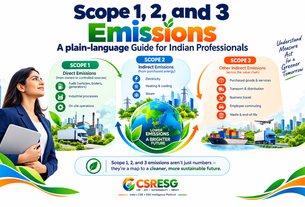
BRSR does not currently require verified Scope 3 (value chain) emissions data in the same depth that frameworks like ISSB or ESRS demand globally. Value chain ESG disclosure requiring companies to collect and report sustainability data from their major suppliers and customers, was introduced and subsequently made temporarily voluntary in 2025, with mandatory adoption expected within the next two to three years. When it arrives, it will pull thousands of unlisted Indian companies, particularly SMEs, into ESG data requirements for the first time, not because SEBI regulates them directly but because their listed clients need their data.
The Bottom Line
BRSR is not another reporting exercise. It is the infrastructure through which India’s corporate sector is being brought into the global ESG data ecosystem, company by company, year by year, with increasing rigour and assurance requirements. Understanding it, in depth and from primary sources, is now a baseline professional requirement for anyone working at the intersection of business, sustainability, and capital markets in India.