


India’s Social Stock Exchange: What it is, What it has built, and What it still needs to deliver
In 2022, India became one of the few countries in the world to launch a Social Stock Exchange, a regulated platform where non-profit organisations and social enterprises can raise capital from mainstream investors through a stock exchange mechanism, with standardised impact disclosure requirements replacing financial returns as the primary accountability metric.
The concept is ambitious enough to be worth unpacking carefully, because it is frequently misunderstood in the development sector (where many practitioners still think of it as a grant mechanism) and in the investment community (where many still have not heard of it).
What the SSE actually is
India’s Social Stock Exchange operates as a segment within the existing NSE and BSE, regulated by SEBI under a framework developed through a high-level committee chaired by Ishaat Hussain. It allows two categories of entities to raise capital:
Non-profit organisations (NPOs) can issue Zero Coupon Zero Principal (ZCZP) bonds, instruments that pay no interest and return no principal but give investors the satisfaction of documented social impact verified by an independent social auditor. ZCZP bonds are effectively a regulated philanthropic instrument: they allow NPOs to access capital from regulated investors (institutions and high-net-worth individuals) at lower transaction costs than traditional fundraising, with standardised impact accountability built into the listing requirements.
For-profit social enterprises (FPSEs) companies whose primary purpose is social impact alongside financial return can list equity on the SSE segment, subject to meeting the SEBI-defined social intent criteria (being in a sector like education, healthcare, agriculture, skill development, or environmental sustainability) and satisfying minimum social impact disclosure requirements.
All SSE issuers must publish an annual social impact report and submit to an independent social audit by a NISM-registered social auditor — the application of financial audit rigour to social impact claims.
What the first two years produced
The SSE’s early track record is honest about both its achievements and its limitations. On the achievement side: India now has a regulated infrastructure for impact capital with standardised disclosure requirements, something that did not exist before 2022. SEBI’s Social Audit Standards give the profession of social auditing a regulatory foundation. The NISM Social Auditor certification creates a career pathway for practitioners with CSR and development sector backgrounds to move into regulated impact assurance work. These are genuine contributions to India’s impact ecosystem.
On the limitation side: the issuer pipeline has been thin. Many eligible NPOs have found the compliance requirements, standardised accounting, impact measurement frameworks, social audit fees, burdensome relative to the capital amounts accessible, particularly for smaller organisations. Investor demand has been limited by unfamiliarity and by the absence of liquidity (ZCZP bonds, once subscribed, cannot be traded). And the minimum subscription amounts for retail investors have kept the platform largely institutional.
What it still needs
The SSE’s promise, democratising impact capital, bringing development finance into the regulatory mainstream, making social impact claims as accountable as financial ones, depends on solving three problems that the current framework has not yet fully addressed.
The first is capacity. Most Indian NPOs do not have the accounting systems, impact measurement frameworks, or governance infrastructure to meet SSE listing requirements. Building that capacity, through training, technical assistance, and phased compliance requirements for smaller organisations is necessary before the issuer pipeline can grow meaningfully.
The second is liquidity. The current absence of a secondary market for ZCZP bonds means investors who subscribe have no exit option. Developing a mechanism for secondary trading, even if restricted to institutional investors, would expand the investor base significantly.
The third is public awareness. The SSE is not yet known to most of the development sector professionals and retail investors who could, in principle, engage with it. The platform needs sustained outreach, not from SEBI alone but from practitioners, trainers, and thought leaders in the ESG and CSR space to translate from regulatory architecture into active market.
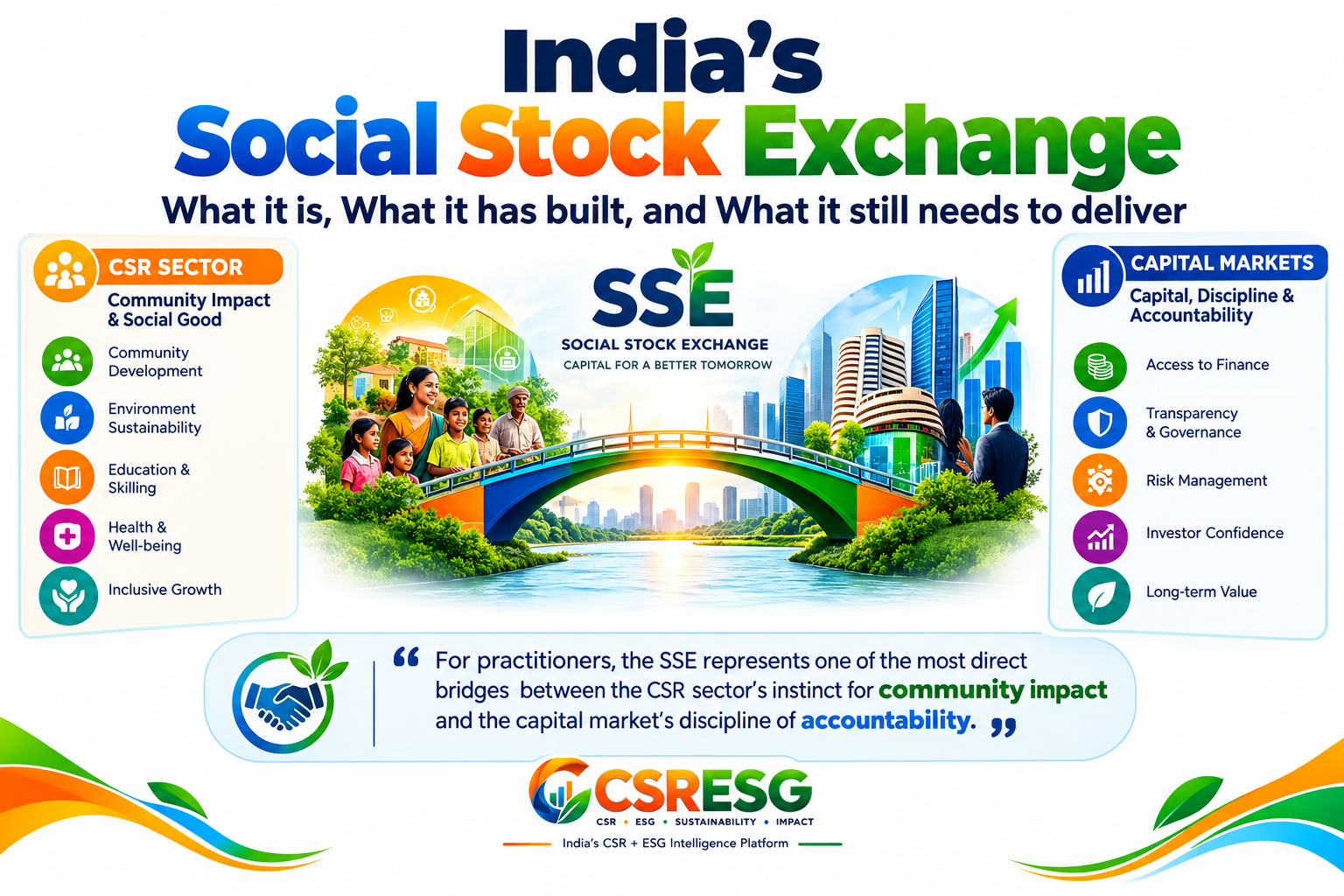
For practitioners, the SSE represents one of the most direct bridges between the CSR sector’s instinct for community impact and the capital market’s discipline of accountability. Those who build expertise in SSE listing requirements, social audit standards, and impact measurement frameworks now are positioning themselves at the frontier of India’s impact investing infrastructure, at exactly the moment when that frontier needs more qualified people.